If you want a phone that shoots crisp photos, runs games smoothly, and lasts all day on a charge, you do not need to spend $1,000. Today, the top smartphones under $500 deliver roughly 85% of the flagship experience for half the price.
Here is the truth: flagship phones reached a plateau years ago. The gap between a $1,200 ultra-tier device and a solid mid-ranger has shrunk to a whisper. Unless you need 100x space zoom or shoot professional log video clips for a living, $500 buys all the phone you will ever need.
Let’s break down which devices are actually worth your hard-earned cash, where they shine, and where they compromise.
What Should You Actually Expect for Under $500?
Five years ago, buying a cheap phone meant accepting a plasticky body, a dim display, and a camera that washed out under indoor lighting. That world is gone.
Right now, sub-$500 devices regularly feature 120Hz OLED screens, aluminum frames, IP67 water resistance, and main camera sensors taken straight from previous flagship models. You can walk into a bright afternoon sun and read your navigation screen without squinting. You can drop your phone in a shallow puddle without panicking.
+-------------------+-----------------------------------+-----------------------------------+
| Feature           | What You Get ($500 Budget)        | What You Miss ($1,000+ Flagship)  |
+-------------------+-----------------------------------+-----------------------------------+
| Screen            | 120Hz AMOLED, Very Bright         | LTPO (1-120Hz dynamic scaling)    |
| Camera            | Great Main Sensor, Good Ultrawide | Dedicated 5x/10x Optical Telephoto|
| Materials         | Glass Front, Plastic/Alloy Frame  | Titanium Frame, Gorilla Armor     |
| Charging          | 25W to 80W Wired                  | Fast Wireless + MagSafe-style     |
+-------------------+-----------------------------------+-----------------------------------+
So where do companies cut costs to hit that magic $499 price tag?
Mainly on secondary lenses and extra features. You will usually get a phenomenal main camera paired with a mediocre 8MP ultrawide lens. You might miss out on wireless charging, or find a plastic back instead of matte glass.
Knowing these trade-offs makes choosing much easier.
Which Mid-Range Phones Offer the Best Value Right Now?
1. Google Pixel 8a — The Camera Champion
If taking great photos of your kids, pets, or travel destinations is your top priority, stop reading here and buy the Pixel 8a.
Google relies heavily on computational photography, meaning software does the heavy lifting to turn decent sensor data into remarkable images. In tricky lighting—like a dimly lit restaurant or a backlit sunset portrait—the Pixel 8a beats devices twice its price.
Quick Specs:
- Screen: 6.1-inch OLED, 120Hz
- Processor: Google Tensor G3
- Main Camera: 64 MP with OIS
- Support: 7 years of OS updates
The Tensor G3 chip inside handles daily tasks with ease, and Google commits to 7 full years of software updates. That long-term support is unmatched at this price level.
What is the catch?
Charging is slow. At 18W, plugging it in takes well over an hour to go from zero to full. The bezels around the display are also thicker than what you see on competing devices from Samsung or OnePlus.
Real-World Take: If you take your phone out at a concert and capture low-light stage shots, the Pixel 8a captures clear skin tones and sharp details while other mid-range options produce blurry watercolor messes.
2. Samsung Galaxy A35 5G — The Safe, Reliable All-Rounder
Samsung understands how to make a complete package. The Galaxy A35 5G does not top the charts in any single benchmark, but it has almost no glaring weaknesses.
The standout feature is its 6.6-inch Super AMOLED screen. It is vibrant, color-accurate, and gets bright enough to cut through harsh glare. If you spend hours watching videos on YouTube or scrolling Reddit, this panel is a treat for your eyes.
Quick Specs:
- Screen: 6.6-inch Super AMOLED, 120Hz
- Battery: 5,000 mAh
- Build: Glass back, IP67 dust/water resistance
- Support: 4 years of OS updates + 5 years security
Samsung also brought its premium “Key Island” frame design and glass back down to the A-series, making the phone feel substantially more expensive than it is.
Where does it lag behind?
The Exynos processor under the hood is fine for everyday multitasking, but high-end 3D games like Genshin Impact will force you to turn graphics down to medium settings to maintain smooth frame rates.
3. OnePlus 12R — The Performance and Battery Powerhouse
Want flagship speed without paying four figures? The OnePlus 12R is a performance monster disguised as a mid-range device.
Powered by the Snapdragon 8 Gen 2 processor—which was running top-tier flagships just a year ago—this device shreds through heavy gaming, video editing, and aggressive multitasking without breaking a sweat.
Quick Specs:
- Processor: Qualcomm Snapdragon 8 Gen 2
- Screen: 6.78-inch LTPO4 AMOLED (1-120Hz)
- Battery & Charging: 5,500 mAh with 80W fast charging
- Weight: 207g
Then there is the battery system. A massive 5,500 mAh battery easily carries you through a day and a half of heavy usage.
When you do run low, the included 80W wired charger takes the battery from 1% to 100% in under 30 minutes. Forget charging overnight; plugging it in while you take a quick morning shower gives you more than enough power for the entire workday.
The trade-off here is the camera suite. While the main 50MP sensor is solid in daylight, the secondary macro and ultrawide cameras are clearly budget add-ons. It also lacks a true IP68 water resistance rating.
4. Nothing Phone (2a) — The Style & Software Standout
Bored of black plastic rectangles? The Nothing Phone (2a) brings genuine personality back to phone design.
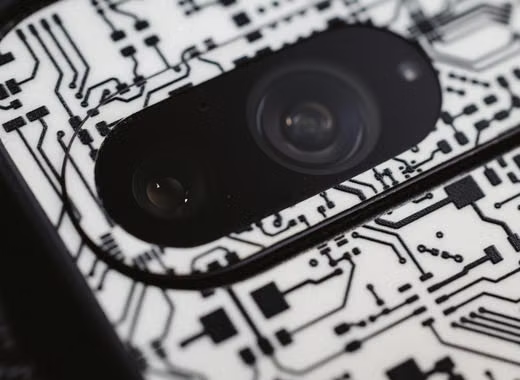
Featuring a semi-transparent back plate exposed alongside white or black accents, it stands out instantly. The signature “Glyph Interface”—a series of LED light strips on the back—flashes for notifications, acts as a volume indicator, and even serves as a fill light for close-up photos.
Quick Specs:
- Screen: 6.7-inch flexible AMOLED, 120Hz
- OS: Nothing OS (Clean, bloatware-free Android)
- Processor: MediaTek Dimensity 7200 Pro
- Battery: 5,000 mAh (45W charging)
Beyond aesthetics, Nothing OS provides one of the cleanest Android experiences available. There are zero pre-installed spam apps, no unwanted games pre-loaded onto your home screen, and the custom dot-matrix widgets look fantastic.
The main compromise is durability materials. The back is made of polycarbonate plastic rather than glass, meaning it shows fine hairline scratches more easily if you carry it without a case.
How Do You Choose the Right Sub-$500 Phone for Your Needs?
Choosing between these devices comes down to identifying what you care about most. Nobody gets everything for under $500, so you have to pick your priority.
  What matters most to you?
  │
  ├── Best Camera & Long Support ───► Pick: Google Pixel 8a
  ├── Gorgeous Display & Build  ───► Pick: Samsung Galaxy A35
  ├── Raw Power & Fast Charging ───► Pick: OnePlus 12R
  └── Unique Design & Clean OS  ───► Pick: Nothing Phone (2a)
Here is a quick rule of thumb:
-
If you take lots of photos: Buy the Pixel 8a. Its processing algorithms handle tricky lighting, moving kids, and dark environments better than anything else near this price.
-
If you game or travel constantly: Buy the OnePlus 12R. The combination of top-tier processing power and 30-minute full charging makes it an absolute workhorse.
-
If you want a reliable screen for media: Buy the Samsung Galaxy A35. You get a gorgeous display, solid build quality, and straightforward software.
What Are the Biggest Mistakes People Make When Buying Mid-Range Phones?
Over the years, I have seen buyers fall into the exact same traps when shopping on a budget. Avoiding these three mistakes will save you from major buyer’s remorse down the road.
Mistake 1: Getting Fooled by Camera Megapixels
Do not let a box that says “108 Megapixels!” fool you. Sensor size, aperture, and image processing software matter far more than raw megapixel counts.
A 50MP main camera on a good sensor with optical image stabilization (OIS) will crush an cheap 108MP sensor every single time.
Also, ignore 2MP “Macro” or “Depth” auxiliary lenses completely. Manufacturers stick those onto budget phones purely to claim they have a “Triple-Camera System” on the retail box. They are useless.
Mistake 2: Ignoring Software Support Timelines
A phone might look great on day one, but what happens in year three?
Some budget manufacturers stop sending software updates after just 12 to 18 months. That leaves your phone vulnerable to security threats and prevents you from getting new Android features.
Stick to brands like Google (7 years of support) or Samsung (4 to 5 years of support) if you plan on holding onto your phone for a long time.
Mistake 3: Overlooking Carrier Band Support
If you buy an unlocked global version of a phone online, check its network bands first.
Imported budget phones often miss specific 5G bands used by major US carriers like T-Mobile, AT&T, or Verizon. You might end up with patchy coverage or slow LTE speeds in places where your friends get full 5G signals. Always verify US carrier compatibility before hitting the buy button.
Frequently Asked Questions (FAQ)
Are top smartphones under $500 good for mobile gaming?
Yes, absolutely. Phones like the OnePlus 12R feature high-end processors like the Snapdragon 8 Gen 2, which runs modern titles like Call of Duty: Mobile or PUBG at high frame rates without overheating.
Do budget phones under $500 have good battery life?
In many cases, sub-$500 phones actually offer better battery life than $1,200 flagships. Because their processors are tuned for efficiency rather than raw max speed, devices with 5,000 mAh batteries easily stretch past a full day of heavy use.
Do smartphones under $500 support wireless charging?
Some do, but it remains a common cost-cutting area. For instance, the Google Pixel 8a includes wireless charging, but it tops out at a slow 7.5W. The OnePlus 12R drops wireless charging entirely in favor of ultra-fast 80W wired power.
How many years will a $500 phone last?
With proper care, a solid mid-range phone easily lasts 3 to 5 years. Devices like the Pixel 8a come with 7 years of promised software and security updates, meaning the software will stay fresh far longer than the physical battery inside.
Final Verdict
You do not need to drain your bank account to carry a fantastic device in your pocket.
If you want the absolute overall winner for balance, camera performance, and software longevity, grab the Google Pixel 8a. It punches well above its weight class and proves that smart hardware choices matter far more than ultra-expensive price tags.
For more Visit TechFuture360.site.