On April 19, 2026, Beijing became the stage for a very unusual race. Humanoid robots joined a half-marathon and surprised many people by running faster than the human winner’s world record time. The event showed how fast robotics is improving, especially in China, where companies and research teams are pushing hard to build smarter and more active machines.
This was not just a fun show. It was also a sign that robots are getting better at balance, movement, and long-distance control. In simple words, the robots did not only walk or stumble. They actually completed a real 21-kilometer race and gave a strong message about the future of humanoid technology.
What Happened in Beijing
The race took place in Beijing E-Town, also known as the Beijing Economic-Technological Development Area. It was the second humanoid robot half-marathon held there. More than 100 robot teams took part this year, which was a big jump from last year’s event. The robots ran on separate tracks from the human runners so that there would be no collision. Around 12,000 human runners also took part in the wider event.
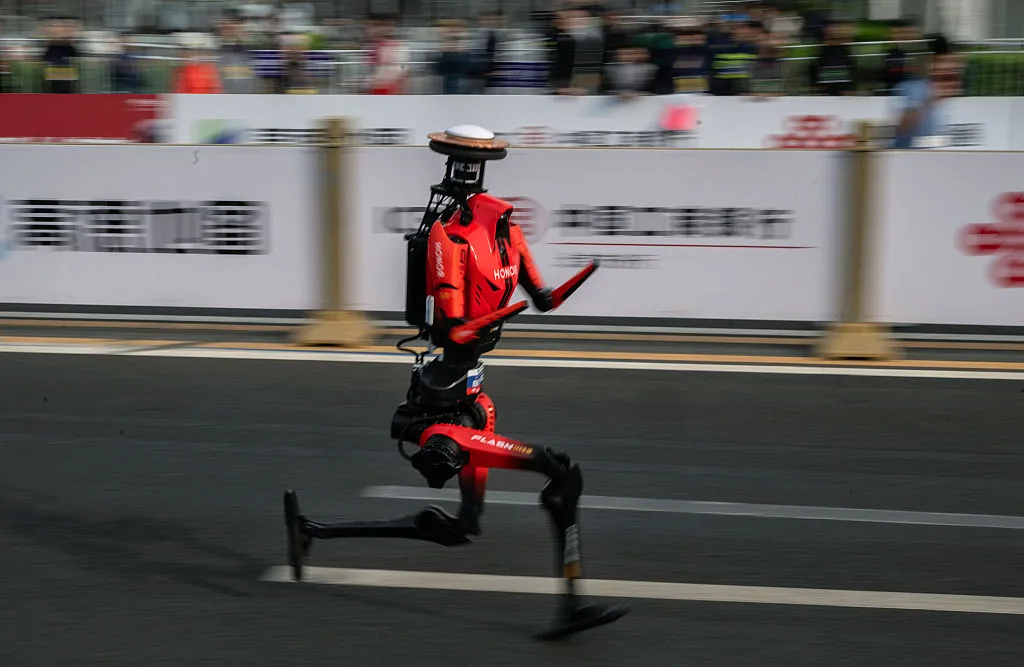
The winning robot came from Honor, a Chinese smartphone company. It finished the 21-kilometer race in 50 minutes and 26 seconds. That time was faster than the men’s half-marathon world record set by Uganda’s Jacob Kiplimo in March in Lisbon, which was about 57 minutes and 20 seconds. This made the robot race a major headline around the world.
Why This Race Got So Much Attention
People were not only excited because robots won. They were excited because the robots looked much better than before. Reuters reported that last year only 20 teams took part, but this year the number rose to more than 100. Reuters also said that nearly half of the robots moved autonomously, instead of being fully guided by people using remote control. That is a major step forward in robotics.
AP also noted that the winning performance was a big improvement from last year’s race, when the top robot finished in 2 hours, 40 minutes, and 42 seconds. In one year, the gap between robots and human athletes became much smaller. That is why many observers see this race as proof of fast technical progress rather than just a publicity event.
How the Winning Robot Managed It
The robot that won came from Honor, and its design was built to copy good human running style. Reuters said the team used long legs of about 90 to 95 centimeters to help the robot move like an elite runner. The robot also used liquid cooling technology, which is related to systems developed in Honor’s smartphones. Engineers said this helped the robot stay stable and keep working for the long distance.
Xinhua reported that the winner, named “Flash,” won in the autonomous category. The report also showed that the top three autonomous robots all came from Honor-related teams, which means the company had a very strong showing in the race. This is important because it shows that the progress was not just about one lucky robot. It was a team-level success.
Autonomous Robots and Remote-Controlled Robots
One of the most important parts of the race was the difference between autonomous robots and remote-controlled robots. According to Reuters and AP, around 40% of the robots moved by themselves. The rest were controlled by people from a distance. This matters because autonomy is one of the hardest problems in robotics. A robot that can run only when a human controls it is useful, but a robot that can make its own movement decisions is much more advanced.
Global Times and Xinhua also reported that the event used a weighted scoring system. That means the robot that crossed the finish line first was not always the official winner if it was remote-controlled. In this race, the autonomous robot got the championship title under the rules, even though another Honor robot that was remotely controlled reached the finish line faster at 48 minutes and 19 seconds. This rule helped reward real machine intelligence, not just human guidance.
The Robots Were Fast, But Not Perfect
Even with the impressive results, the race was not clean and easy for every robot. AP reported that one robot fell flat at the start line, and another bumped into a barrier. Reuters also said that the event still showed how young the technology is, even though the progress was clear. So the race was both a success and a reminder that humanoid robots still have many limits.
Xinhua’s images from the event showed robots falling, getting battery changes, and being helped by support teams. That tells us something important: these machines are still not independent in the full human sense. They still need engineers, batteries, and close care. So while the race was impressive, it was also a controlled test, not a normal real-world sports competition.
What People Saw at the Event
Spectators were amazed by the robots. AP quoted viewers who said they felt a huge change from last year and said they never imagined robots could pass humans in this kind of race. Reuters also reported that students and children were excited by what they saw. For many people, the event was not just about speed. It was about seeing the future in front of their eyes.
The race also created a strong visual contrast. Human runners were doing a normal half-marathon, while robots were running beside them on a separate path. This made the event feel like two worlds meeting at once: human sport and machine technology. That mix is one reason why the story spread so quickly across international media.
Why China Is Pushing Humanoid Robots So Hard
China is putting a lot of effort into robotics. AP reported that the country’s latest five-year plan says it wants to focus on the frontiers of science and technology, and humanoid robots are part of that push. Reuters also noted that China already has a very large robotics market and strong companies working in the field. This marathon was therefore not just a race. It was also a public sign of a bigger national strategy.
Reuters also reported that Omdia ranked Chinese firms AGIBOT, Unitree Robotics, and UBTech Robotics as top vendors in the global market for general-purpose embodied intelligent robots. That shows China is not only building robot demos. It is also building a real industry. The half-marathon made that industrial progress easy for the public to see.
What This Means for the Future
This race does not mean humanoid robots are ready to replace humans in daily life. Reuters was careful to say that the sector is still in a nascent phase, or in early development. The robots still struggle with difficult terrain, balance, power use, and full independence. They are much better than before, but they are not close to doing every job a person can do.
Still, the progress is real. A robot finishing a half-marathon in under 51 minutes is a strong signal that robotics hardware, control systems, and cooling systems are improving fast. Reuters also said that some of these technologies could later help in industrial areas like manufacturing. That is a practical point: the same systems that help a robot run smoothly may one day help it work better in factories, warehouses, or other workplaces.
At the same time, experts still warn that sports performance does not mean full real-world intelligence. A robot that can run well in a controlled race still may not be ready for jobs that need fine hand skills, quick thinking in messy places, or safe interaction with people. So the half-marathon should be seen as a big milestone, but not as the final answer to what robots can do.
Human Reaction and the Bigger Message
The reaction to the race was a mix of surprise, curiosity, and excitement. Many viewers saw it as a moment that could mark a new era. Others saw it as proof that science fiction ideas are becoming real much faster than expected. The image of a humanoid robot crossing the finish line before human-level marathon times is powerful, and that is why the story spread so widely.
The bigger message is simple. Robotics is moving from slow demos to real tests. A year ago, the same kind of event looked messy and awkward. This year, the machines were far more stable, faster, and more intelligent in movement. That kind of leap in one year suggests that the next few years may bring even bigger changes.
Conclusion
The Beijing humanoid robot half-marathon was more than a race. It was a clear sign of rapid progress in artificial intelligence, robot movement, battery support, and machine control. The winning robot from Honor finished in 50 minutes and 26 seconds, beating the human half-marathon world record time and shocking many people around the world.
At the same time, the event also showed that humanoid robots are still developing. Some robots fell, some needed help, and many were still remotely controlled. But the direction is clear: the machines are getting better very fast. That is why the 2026 Beijing race will be remembered as one of the most important robot stories of the year.
For more, visit Techfuture360.site.