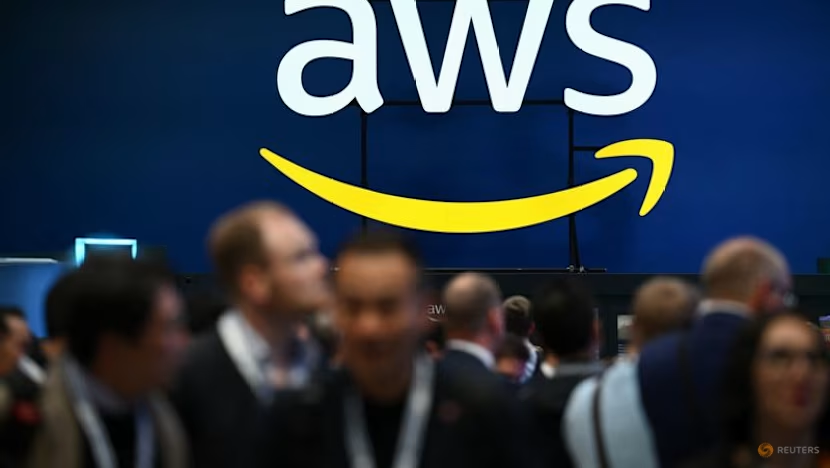
Amazon Web Services has launched a new AI application called Amazon Bio Discovery to help scientists speed up early drug discovery. The announcement came on April 14, 2026, and the main idea is simple: let researchers design and test drug ideas faster, with less manual work and less coding. AWS says the tool is built to help scientists find and improve drug candidates in the early stages of research.
This matters because early drug discovery is usually slow, expensive, and full of repeated trial and error. Scientists often need to test many ideas before they find a strong one. Amazon’s new tool is meant to make that process faster by using AI models, AI agents, and lab feedback in one flow.
What Amazon Bio Discovery is
Amazon Bio Discovery is an AI-powered application made for life sciences research. AWS says it gives scientists direct access to specialized biological AI models, often called biological foundation models or bioFMs, which are trained on large biological data sets. These models can generate and evaluate possible drug molecules, especially antibody-based candidates.
The key point is that this tool is not only for AI experts. AWS says it is designed so scientists can use it even if they do not write code every day. In the Reuters report, AWS said the platform lets researchers run complex computational workflows without writing code, which lowers the technical barrier for drug discovery teams.
In simple words, Amazon is trying to make drug research feel more like a guided system. The scientist still leads the work, but the AI helps with the heavy lifting, the ranking of candidates, and the next best step. AWS says the goal is to help more researchers use these tools directly, not only computational biologists or machine learning specialists.
How the tool works
AWS describes Amazon Bio Discovery as a lab-in-the-loop system. That means the AI does not work alone. It helps design candidates, then those candidates go to lab partners for synthesis and testing, and the test results come back into the system to improve the next round of ideas. This cycle is meant to keep getting better with each experiment.
The process has several parts. First, scientists can use a catalog of models and choose the one that fits their research goal. Then AI agents help them set the right inputs and organize the workflow. After that, the system generates ranked candidates based on things like structural confidence, binding affinity, and humanness. Finally, the best candidates can be sent to integrated lab partners for synthesis and testing.
AWS also says the application gives researchers built-in benchmarks and reusable pipelines. That is useful because drug discovery teams often repeat similar tasks across many projects. With reusable workflows, teams can save time and keep their research more consistent.
Why this matters for drug discovery
Early drug discovery usually takes a long time because the number of possible molecules is huge. Researchers must look at many options, narrow them down, test them, learn from the results, and repeat the process. AWS says its new tool is meant to reduce that waiting time and make the process more efficient. In Reuters’ report, AWS executive Rajiv Chopra said a task that could take 18 months to produce around 300 drug candidates could now be done in a couple of weeks.
That is a big promise, but it does not mean the whole drug development process becomes instant. The tool focuses on the early stage, where ideas are generated and tested before they move into deeper lab work. That is often the stage where speed can matter most, because better early choices can save time and money later. AWS’s announcement says the system is built to help scientists design and test novel drugs more quickly and confidently.
The change is also about access. AWS says the platform is made so more scientists can use advanced AI without needing to build everything from scratch. In practice, that could help smaller teams move faster and help larger teams handle more research programs at once.
Real-world use and early adopters
AWS says Amazon Bio Discovery has already been used with Memorial Sloan Kettering Cancer Center to accelerate antibody design for pediatric cancer research. According to AWS, that collaboration used AI agents to orchestrate multiple models and helped design nearly 300,000 novel antibody molecules, then narrow them to 100,000 candidates for lab testing. AWS says work that can take up to a year with traditional methods was reduced to weeks from design to lab testing.
Reuters also reported that Bayer, the Broad Institute, and Voyager Therapeutics are among the early adopters of the platform. AWS said that 19 of the top 20 global pharmaceutical companies already use its cloud services, which gives the new product a strong base of potential users.
The quotes AWS included on its product page show the kind of problem this tool is trying to solve. One researcher said training models in one place and using them in another took too much effort, while another said the application gives a convenient way to apply new AI models for novel molecule design and evaluation. These comments suggest the big value is not just speed, but also smoother teamwork between AI work and wet-lab work.
What makes this different from older tools
Amazon Bio Discovery is not just a single model or a simple chatbot. AWS says it combines model access, AI agents, workflow setup, candidate ranking, and lab feedback in one application. That is important because drug discovery usually breaks down when systems are disconnected. A team may have strong models, but if the workflow is messy, the research slows down. AWS says its new system is designed to fix that gap.
The tool also includes a reasoning layer. AWS says the agent can help explain why it is choosing certain candidates and can reference literature while doing so. That kind of guidance can make the system easier to trust and easier to use for scientists who want to understand the logic behind the output, not just receive a score.
Another key difference is the feedback loop. The system is meant to learn from wet-lab results and use those results to improve future runs. This is a strong idea because drug discovery is not one big guess. It is many small steps, where each result helps shape the next round of research. AWS says this creates an institutional knowledge cycle that grows over time.
What AWS is saying about the future
AWS is clearly betting that agentic AI will become a bigger part of life sciences. The company’s Life Sciences Symposium 2026 page says the event focuses on AI-driven discovery, development, and patient impact, with research and drug discovery as a major theme. That shows Amazon is not treating Bio Discovery as a one-off product, but as part of a wider life sciences strategy.
AWS already offers other life sciences tools too, including AWS HealthOmics for drug discovery, which it says helps researchers run biological foundation models and bioinformatics workflows while handling complex infrastructure for them. That suggests Amazon wants to support the full research path, from data and model work to testing and later development.
The company is also positioning Bio Discovery as something users can try now. AWS says the product is available today, with a free trial and a free digital course for training. Reuters reported that AWS will start with a free trial offering before moving to subscription tiers.
The limits and the careful side of the story
Even with strong AI, drug discovery still needs real experiments. Amazon Bio Discovery does not replace lab work. It helps scientists choose better candidates, but the molecules still have to be synthesized, tested, and checked in the real world. AWS and Reuters both describe the service as a tool to augment, not replace, scientists and research partners.
There is also a business side to the launch. Reuters says Amazon will offer a free trial first and then move to subscription pricing. That means the company is not only launching a research tool, but also creating a product that it expects life sciences customers to adopt as part of their regular workflow.
So the smartest way to see this launch is not as magic, but as a practical upgrade. It is an attempt to reduce friction, shorten early research cycles, and make advanced AI easier for scientists to use every day. If it works well in real projects, it could become one of Amazon’s most important life sciences products.
Conclusion
Amazon Bio Discovery is a major new move in AI-powered drug research. It brings together biological AI models, AI agents, workflow help, and lab feedback in one system. AWS says the tool is built to make early drug discovery faster, easier, and more accessible to scientists who are not coding experts. The biggest promise is time: weeks instead of months or even years for some early-stage work.
For now, the launch shows where Amazon thinks the future is going. The future of drug discovery may not belong only to bigger labs or more code-heavy teams. It may belong to teams that can combine smart AI with real lab testing in one smooth flow. That is the direction AWS is clearly pushing with Amazon Bio Discovery.
For more, visit Techfuture360.site.